

- Role
- Software Engineer · MSc Research
- Exploration · MSc research · Backend systems
- Service
- Automation + AI
The problem
Backend faults often require an operator to diagnose the cause, choose a safe recovery action, and verify the result. The research asked how a rules-based system and an AI-assisted system would handle the same faults under controlled conditions.
What I explored
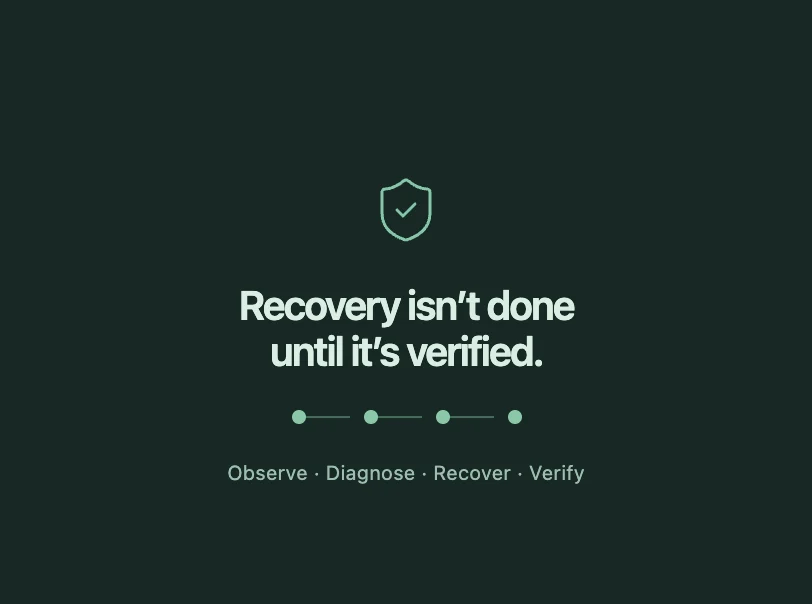
I built a local Docker Compose testbed with a managed backend and a separate service that monitors it and coordinates recovery. I implemented a rule-based baseline and two AI-assisted recovery strategies. Each strategy executes through the same policy checks and list of allowed actions. The system checks fresh health evidence before declaring recovery and escalates when the policy requires it. I also built a local operator dashboard and experiment tooling to inject controlled faults and record decisions, actions, and results.
What I learned
The testbed produced recorded local evidence for comparing recovery strategies, including verified recovery, escalation, timing, and safety checks.
Key features
Tools and technologies
Ask about Self-Healing Backend Ops
Available for new projects
Have a workflow that takes too much manual work?
Let’s connect the tools you already use and simplify the steps your team repeats.
 Freemancodz
 LinkedIn